

As a school district leader, you operate as the chief executive of a highly complex, deeply human organization. You possess the visionary expertise, the academic background, and the profound dedication required to steer your schools toward greatness. You know exactly where your district needs to go. However, navigating daily triage while driving culture change is difficult without a structured system. Implementing a dedicated leadership engagement program is the key to turning your district’s vision into measurable reality.
Leading a district today requires managing a collision of compounding crises. We see the data, feel the shift, and understand the stakes. Right now, the educational ecosystem faces a retention crisis that actively threatens the stability of our schools. Recent national data compiled by researchers reveals a stark reality for the 2025–2026 school year: there are at least 56,000 completely vacant teaching positions across the United States, along with 350,000 positions filled by underqualified educators. Making matters worse, the data shows a stagnation in enrollment for teacher certification programs across most states.
Furthermore, teacher attrition accounts for approximately 90% of the annual demand for new hires, according to the Learning Policy Institute. Educators frequently leave due to job dissatisfaction, lack of professional support, and challenging workplace conditions. In fact, surveys from Education Week show that up to 44% of current teachers indicate they are likely to leave the profession within the next two years.
The Ripple Effect: Morale, Achievement, and Attendance
This mass exodus leaves a deep, aching mark on the heart of your schools. Low morale actively corrodes the joy of teaching and the efficacy of instruction. According to the EdWeek Research Center’s 2026 State of Teaching report, the national Teacher Morale Index recently slipped from +18 down to a precarious +13 (on a scale of -100 to +100). Educators point to worsening student behavior, inadequate planning time, and political polarization as the root causes of their exhaustion. Budget constraints compound this systemic stress, triggering layoffs, increased class sizes, and immediate drops in staff spirits.
Concurrently, you face the relentless push to elevate student achievement and reverse a decade-long learning recession. According to data from the Education Recovery Scorecard, eighth-grade reading scores currently sit at their lowest point since 1990. On top of that, catastrophic learning losses in high-poverty districts left students an average of 0.7 grade levels behind in math between 2019 and 2022, creating an incredibly steep hill for educators to climb.
A primary headwind suppressing achievement efforts is a devastating attendance crisis. According to the latest data published by Education Week, 23% of students were chronically absent during the 2024–2025 school year, leaving the national average roughly 50% higher than pre-pandemic baselines. You know deeply that a leader cannot successfully mend student achievement if they cannot stabilize their staff and get students back in seats.
Despite these hurdles, the strongest school districts share one thing: leaders who actively engage employees while executing toward measurable outcomes achieve the strongest results. They create meaningful conversations, communicate consistently, recognize work that matters, and act on what they hear.
The Rearview Mirror: Evolving Beyond the Annual Survey
In the quest to implement teacher and staff retention strategies and improve school culture, districts historically lean heavily on the annual staff survey. While helpful, surveys provide a static x-ray of the district. They capture a single moment in time, delivering a photograph of the past.
Using an annual survey to guide daily district culture is akin to navigating a cross-country road trip using a map printed a year ago. To lead dynamically, you need a living, breathing pulse. Rounding gives you a real-time pulse—the data to know if what you’re leading is having the impact you intend. You need immediate data to know if the initiatives you champion are landing effectively at the building level.
Of course, time is your most fiercely protected resource. The demand for continuous improvement in education frequently feels overwhelming. Integrating a new methodology into your district requires strategy and precision. Rather than adding more work, leader rounding provides a framework that improves the unstructured check-ins your leaders are already doing, yielding exponentially more value from every single conversation. In short, we optimize the interactions already happening in your hallways and classrooms.
The Core of a Successful Leadership Engagement Program: Leader Rounding
Building a culture of profound trust requires building a discipline of profound listening.
At the center of exceptional district culture—and the foundation of our leadership engagement program—is Leader Rounding. Rounding is a structured, recurring conversation between leaders and the people closest to the work. Leaders who listen build cultures that speak, and cultures that speak build leaders who listen.
Done well, rounding builds trust, surfaces what’s working and what isn’t, generates the recognition employees need to know they matter, and drives the continuous improvement that moves districts forward.
This practice transforms leadership. We evolve from isolated acts of leadership engagement to aligned leadership engagement that drives district results. When the superintendent, the cabinet, and the building principals all engage staff with the identical structured discipline, the entire organization moves with singular, unstoppable momentum.
The Proof: Outperforming National Benchmarks
Great leadership relies on evidence. Studer Education has partnered with over 350 school districts for more than 15 years to install the leadership disciplines behind strong culture, engaged staff, and improved student outcomes. Twelve of those superintendents have been named Superintendent of the Year in their respective states in just the last three years.
When districts embrace targeted K12 leadership coaching and commit to this discipline, the results are wildly consistent and deeply measurable. Studer Partner Districts outperform national benchmarks across the board:
- Math on Grade Level: 42.6% vs. 38%
- Literacy on Grade Level: 47.9% vs. 42%
- Graduation Rate: 89.8% vs. 87%
- Chronic Absenteeism: 23.1% vs. 25%
- Employee Retention: 94.5% vs. 93%
This framework provides robust chronic absenteeism solutions and builds fierce district cabinet alignment. In the districts that go deepest, the results compound magnificently.
For example, Estacada School District in Oregon experienced a 37% lift in on-time graduation. Superintendent Dr. Ryan Carpenter notes, “In 2017 we had a 54% on-time graduation rate. We now have a 91% on-time rate. In 2019 we started this work. The rest is history.”
Similarly, Visions in Education in California lifted staff retention from 83% to an incredible 95%. Superintendent Dr. Steve Olmos states, “My first year, we had about an 83% staff retention rate. This last year, our retention rate of our staff was actually 95%.”
Meanwhile, Hemet Unified in California brought student expulsions down from 160 to fewer than 15. Superintendent Dr. Christi Barrett proudly affirms, “We are absolutely leading the results on behalf of students, and not simply getting lucky with our outcomes.”
These are predictable outcomes of rounding practiced with discipline. You engage employees consistently, you listen with intention, and you act decisively on what you hear.
The Solution: The 90-Day Leadership Engagement Program
To empower your district with these exact disciplines, we engineered the Leadership Engagement Program. This is a hyper-focused, 90-day sprint designed explicitly for the busy district leader. The program installs the rounding practice in a district through 90 days of structured coaching and disciplined follow-through.
This is the premier path for school district leadership development. During the program, up to three leaders work directly with a dedicated Studer Education coach through eight structured virtual coaching sessions. It serves as an elite form of superintendent leadership training and robust principal professional development. Like assembling a brilliant brain trust, this program ensures your cabinet’s unique talents unite under one cohesive, unstoppable strategy.
Through the expert guidance of a dedicated coach, leaders master the following critical steps:
- Round with Intention: Conduct structured conversations that surface what’s working, what isn’t, and who deserves recognition.
- Capture What You Hear: Document every conversation, recognition, and follow-up lives in K12 Rounding, making rounding repeatable, trackable, and visible.
- Analyze Patterns with AI: Leverage K12 Rounding’s AI to identify themes. You will effortlessly distinguish signal from noise, harvest bright spots, and pull the top three themes worth acting on.
- Communicate Key Learnings: Use the 3-2-1 process to translate three wins, two improvements, and one action into a district-wide message.
- Improve What Staff Identify: Construct an improvement plan to address what staff communicate as opportunities for improvement.
The 90-day arc follows five distinct, powerful stages: Frame, Launch, Refine, Analyze, and Improve. Each session builds on the last and includes a between-session action step that moves learning into practice.
Your 90-Day Blueprint Includes:
- 8 Coaching Sessions: 45 minutes each, virtual, delivered by a Studer Education coach. Each session is anchored to a specific leadership tactic.
- K12 Rounding Platform Access: Three platform seats. Capture rounding conversations; surface themes through AI analysis; manage recognition and follow-up.
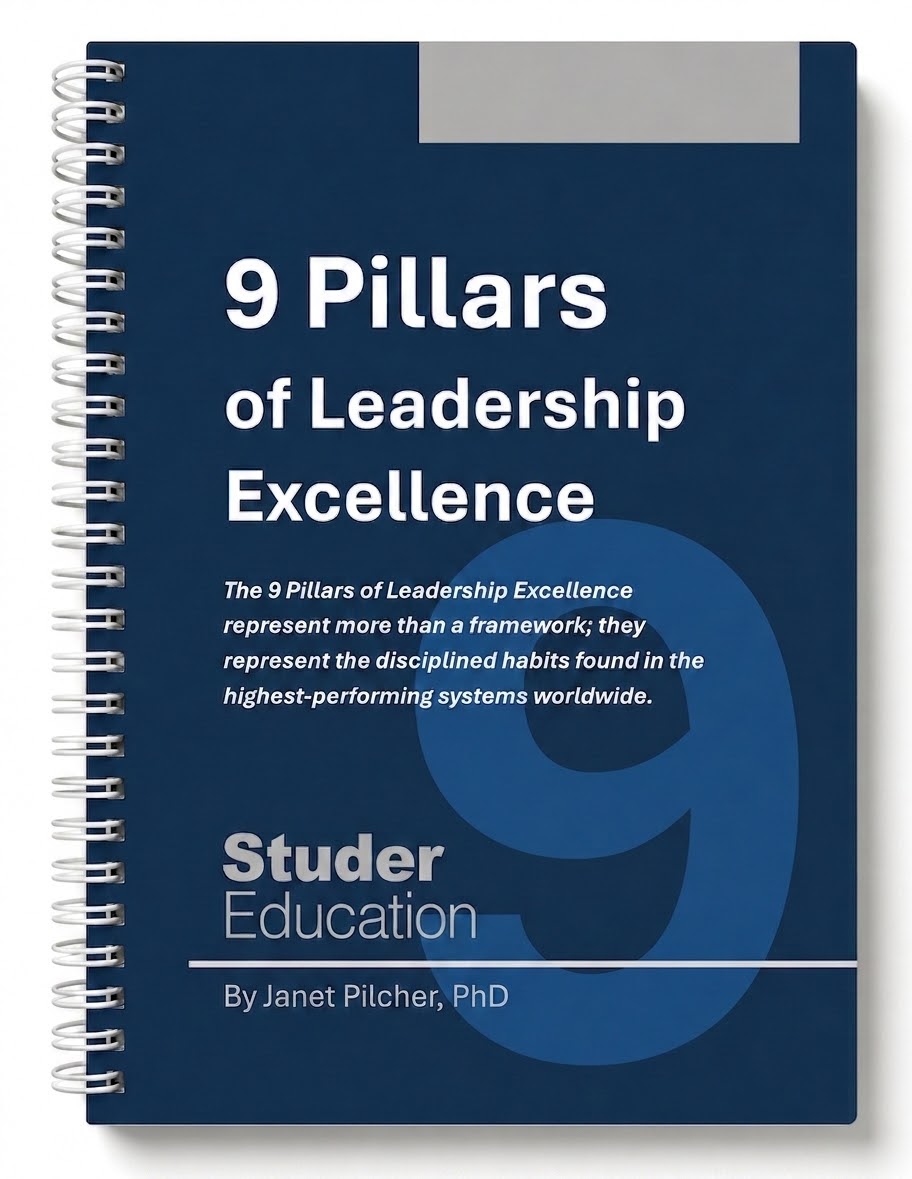
- 9 Pillars Desk Reference Guides: Three spiral-bound copies of the leadership framework behind every Studer Education partnership.
- Studer Online Access: Three accounts providing an on-demand learning library that reinforces every session.
Your Next Step Toward Unstoppable Leadership
Trust requires time, transparency, and truth. By committing to this structured, 90-day cycle, you demonstrate to your staff that their voices represent the most valuable asset in your entire district. Genuine engagement demands discipline and action.
Ask yourself: What would it be worth to your district to keep one more great employee next year? The Leadership Engagement Program is an investment that costs less than replacing a single teacher. It is designed to keep your employees engaged, satisfied, and deeply valued in their work. More importantly, it equips your cabinet and principals with the exact practice required to be true engaged leaders driving real change across the district.
The gap between knowing what your district needs and getting the tools to execute it is often stalled by bureaucratic red tape. This program bridges that gap. Purposely designed as an accessible, immediate step forward, the investment falls below standard district RFP thresholds. This allows you to bypass long board approval queues and start building a stronger culture next week, not next semester.
You already possess the brilliance to lead your district to the mountaintop. Now, give yourself the framework to get everyone there together.
Take action today. We offer flexible avenues to begin your journey:
- Share this Blueprint: Distribute this article to your cabinet and building leaders to ignite the conversation around structured engagement.
- Align with an Expert: Book a brief discovery call to discuss how this 90-day cycle fits seamlessly into your current strategic plan.
- Launch Immediately: Purchase online via the Studer Education Store to begin your first coaching session next week.
Enroll in the 90-Day Leadership Engagement Program today, and guarantee your district’s success.
Strategic Planning in Education FAQs
A highly effective strategic plan typically defines organizational success and outlines a clear, bold vision for five years from its creation.
The process requires input from diverse stakeholder groups to guarantee deep inclusivity. This includes internal and external focus groups comprising executive leaders, classified staff, teachers, parents, students, business leaders, and community partners.
A vision statement defines the ultimate definition of organizational success five years from now. The strategic plan encompasses that vision alongside the specific, prioritized strategies, overarching goals, and core values required to achieve it.
You secure undeniable buy-in by making the strategic planning process fiercely collaborative. Engage internal stakeholders through focus groups and surveys, ensuring their voices actively shape the current assessment and future priorities. When educators and community members see their exact fingerprints on the final plan, they invest emotionally and fully in its success.