

Every systemic breakthrough in a district traces back to a highly supported leadership team. Yet, the daily realities of administration constantly threaten that momentum. Principals burn out. Institutional memory walks out the door. Practices fracture from one campus to the next. The talent pipeline runs dry. Prioritizing school leadership development immediately resolves these challenges by converting daily friction into forward momentum. You shape the leaders; the leaders shape the system.
This guide provides the strategic, road-tested framework you need to build capacity across every campus. By anchoring your practice in leadership coaching and continuous feedback, you empower your administrators to confidently master the complexities of the school year.
What Is School Leadership Development, and Why Does It Matter?
School leadership development is the systematic, operational process districts use to sharpen executive decision-making, refine administrative skills, and boost overall organizational efficacy. Effective school districts function as networks of strong, collaborative, and committed people working in mutually beneficial relationships. When you intentionally cultivate these networks through continuous educational leadership development, the investment yields profound dividends:
- Staff engagement deepens because professionals feel seen, valued, and heard.
- School culture stabilizes into a resilient ecosystem of trust.
- Student success accelerates because supported principals cultivate supported teachers.
Leaders must create the kinds of work environments in which people thrive and do their best work. Leadership development remains a top priority for achieving excellence and serves as the surest way to attract and retain talented professionals. Because organizational performance depends completely on the performance levels of its people, equipping individuals with actionable tools and insights empowers them to confidently elevate their entire teams. Excellence requires an ongoing, passionate commitment to growth and a dedication to daily, habitual improvement.
Why Leadership Development Is Essential for Long-Term District Success
Sustainable district improvement depends entirely on leaders who consistently guide teams, gracefully navigate intense challenges, and relentlessly support organizational goals. Capacity dictates execution. Exceptional leadership capacity deeply influences clear communication, strict accountability, and cultural alignment throughout a district.
High-performing leaders possess a relentless drive to achieve organizational success while building a profound sense of community. They embrace a people-first philosophy that explicitly prioritizes the growth, well-being, and advancement of every employee. As you continuously advance your own skills and coach your teams to do the same, momentum builds and results dramatically improve.
Developing your leaders creates long-term organizational stability. Districts must replace the exhausting reliance on individual “hero leaders” with repeatable, robust systems. Building your bench strength reduces dependence on individual personalities, ensuring the district thrives regardless of who holds the title.
By actively managing human performance and developing high-capacity teams, you successfully shift your district’s performance curve right and tight, creating an environment with less variability where individuals consistently perform at higher levels.
How Leadership Coaching Accelerates Professional Growth
Effective leadership coaching accelerates professional growth by offering real-world, highly relevant support exactly when the pressure mounts. A coach sets the vision and inspires individuals to be better than they thought they could be. Coaches achieve this through frequent and specific feedback, setting high expectations, training, and coaching in the moment. People learn best when they receive specific feedback exactly as they apply a new practice. Exceptional coaches guide administrators by setting crystal-clear expectations, modeling desired behaviors, and delivering highly actionable feedback.
Coaching helps leaders improve complex problem-solving, elevate crisis communication, and drastically deepen self-awareness. You share with individuals not just how to move from good to great, but exactly what they should stop doing to achieve consistent high performance.
As a coach, you actively reinforce positive behaviors, expertly identify performance gaps, and productively engage in dialogue to course-correct smoothly. Because the approach you take directly influences how your people perform, this real-time partnership ensures your leaders feel entirely supported. High-performing leaders judge their success by their team’s success and believe they haven’t led well until their teams have performed well.
Why Continuous Feedback Drives Leadership Improvement
Leadership growth crystallizes when continuous feedback is timely, specific, and unyielding. Continuous learning and feedback allow people to celebrate the bright spots, identify areas for improvement, and make adjustments as learning occurs. These rapid feedback loops create immediate opportunities for deep reflection and proactive course correction.
Leaders tackle tiny adjustments immediately to prevent minor misunderstandings from metastasizing into major crises. Delivering feedback in real time makes learning relevant and integrated into everyday practice. By applying a continuous learning and feedback model, you guarantee that learning remains ongoing, occurs in real time, and is reinforced through constant improvement dialogue. This strategic approach directly supports both individual and organizational growth, leading to significantly higher engagement and elite performance across your district.
Furthermore, you master the delivery of this guidance by offering descriptive feedback in a way that keeps employees highly motivated to refine their practices. For instance, highly effective leaders utilize the three-to-one rule, knowing it takes three compliments to one constructive comment to create a truly positive and impactful interaction. When you acknowledge positive behaviors before offering constructive guidance, individuals respond enthusiastically and accelerate their own development.
Moving Beyond Annual Evaluations: Creating a Culture of Ongoing Development
Organizations maximize growth by embedding coaching directly into the daily operational heartbeat of the district. Approaching school leadership development as an unremarkable, daily habit ensures individuals constantly refine their craft. You must build systems that normalize reflection and prioritize daily growth conversations.
You accelerate leadership capacity by designing Continuous Learning and Improvement Institutes. These scheduled, highly focused sessions empower leaders to master new skills and solve real-world problems of practice in real time. You aggressively cascade this continuous learning model directly to your teams, enabling them to completely follow suit and predictably achieve targeted results.
Institutionalize rapid growth through strategic habits like coaching walkthroughs—short, highly supportive observations that provide immediate, evidence-based formative feedback. Deliberately blocking time on your calendar for these critical observations guarantees that the subsequent follow-up conversations actually occur. Observe the action. Reflect on the impact. Engage the leader.
By embedding these structured, daily interactions into the very fabric of your district, you guarantee that skill development aligns perfectly with your most critical organizational priorities.
Coaching in the Moment: Supporting Leadership Growth Through Daily Interactions
The most helpful feedback occurs “in the moment,” as leaders observe the behavior. Like a master teacher scanning a classroom, education leaders leverage real-time observations, hallway conversations, and immediate challenges as rich coaching moments. Every day, you see employees performing exceptionally well, and you identify distinct areas for growth. Exceptional leaders refuse to let these fleeting moments pass by unaddressed. Instead, you offer precise feedback on the spot.
Immediate feedback creates stickier learning opportunities because the context remains fresh, and the stakes are relevant. This practice requires leaders to acknowledge positive behaviors immediately and to address areas for improvement exactly when they happen. How you coach people and the specific words you choose during these real-time experiences become critical to driving positive behavioral change.
Rather than offering a generic compliment, you ask probing questions such as, “What was going through your mind when you did that?” This strategic questioning transforms a simple observation into a powerful two-way conversation. Elevate the interaction. Empower the employee. Expand their capacity. By asking the right questions precisely when the behavior occurs, you make learning deeply relevant.
How Performance Conversations Help Leaders Improve and Grow
Exceptional leaders lean into difficult dialogue with immense courage. Constructive performance conversations provide essential clarity, enforce strict accountability, and offer genuine support for improvement. These crucial discussions serve as profound opportunities for professional alignment and deep development. Of all the approaches available to educators to promote learning, the most powerful remains the professional conversation.
As a coach for your employees, you actively reinforce positive behaviors, clearly identify where performance gaps exist, and engage in productive dialogue to course-correct smoothly. It remains critical to hold individuals firmly accountable to your organizational values and standards. Consider the profound leadership maxim: what you permit, you promote. If you ignore negative behaviors, they become fully accepted within your culture.
Your willingness and ability to constructively address undesirable behaviors can make or break your organization’s ability to meet its goals. The capacity to master crucial conversations does not simply predict individual effectiveness; it is also one of the most potent drivers of organizational performance. Trust is built in the crucible of honest feedback.
How to Use Performance Curve Conversations to Support Leadership Accountability
Leaders constantly manage individuals operating at vastly different stages of readiness. The organizational human performance continuum categorizes individuals into four groups: high performers, high-solid performers, low-solid performers, and low performers.
Roughly 30% are high performers, 60% are solid performers, and 10% are low performers. Performance directly results from an individual’s will to do the work and their actual skill to execute it. Understanding exactly where people consistently excel allows you to strategically identify strengths to build upon. Structured conversations help leaders pinpoint precise strengths, isolate growth opportunities, and establish explicit next steps.
- High performers need to hear that leaders want them to stay.
- Solid performers need good coaching from their leaders to maximize their impact and readiness for future leadership roles.
- Low-solid performers need structure and clear direction from leaders.
- Low performers require highly directed, focused feedback paired with explicit consequences for a lack of improvement.
If you fail to address low-performing behaviors, the performance gap becomes intolerable for your highest achievers, and overall district results begin to decline. Tailoring your coaching inextricably links accountability and development as complementary duties.
How Do Districts Build a Leadership Development System That Lasts?
Breakthrough performance happens when districts hardwire coaching, continuous feedback, and accountability directly into everyday operational practices. You ensure your school leadership development framework relies entirely on deeply ingrained daily habits.
As human performance improves across the board, the performance curve narrows and shifts to the right, meaning individuals consistently perform at much higher levels with significantly less variability. Managing this performance involves expertly mastering relationship-building, proactive coaching, formal evaluation, and critical conversations.
Strong districts intentionally engineer their future leaders like a championship franchise building a dynasty. They build robust pipelines that naturally elevate talent from within. Organizations achieve breakthrough performance when skilled leaders continually improve their own skills while developing their teams.
By actively applying evidence-based leadership practices, you shift sporadic, unpredictable organizational results into consistent, powerful upward trends. Cultivating this culture of excellence requires a proven roadmap and an experienced partner to help navigate the complexities of organizational change.
How Studer Education Supports School Leadership Development
Studer Education partners with educational leaders to improve student outcomes by strengthening people, processes, and structures that power educational systems. We help districts design leadership systems centered on coaching, continuous feedback, and intentional growth to drive pure organizational excellence. By aligning these daily practices with your strategic goals, we ensure your leadership pipeline remains vibrant and capable.
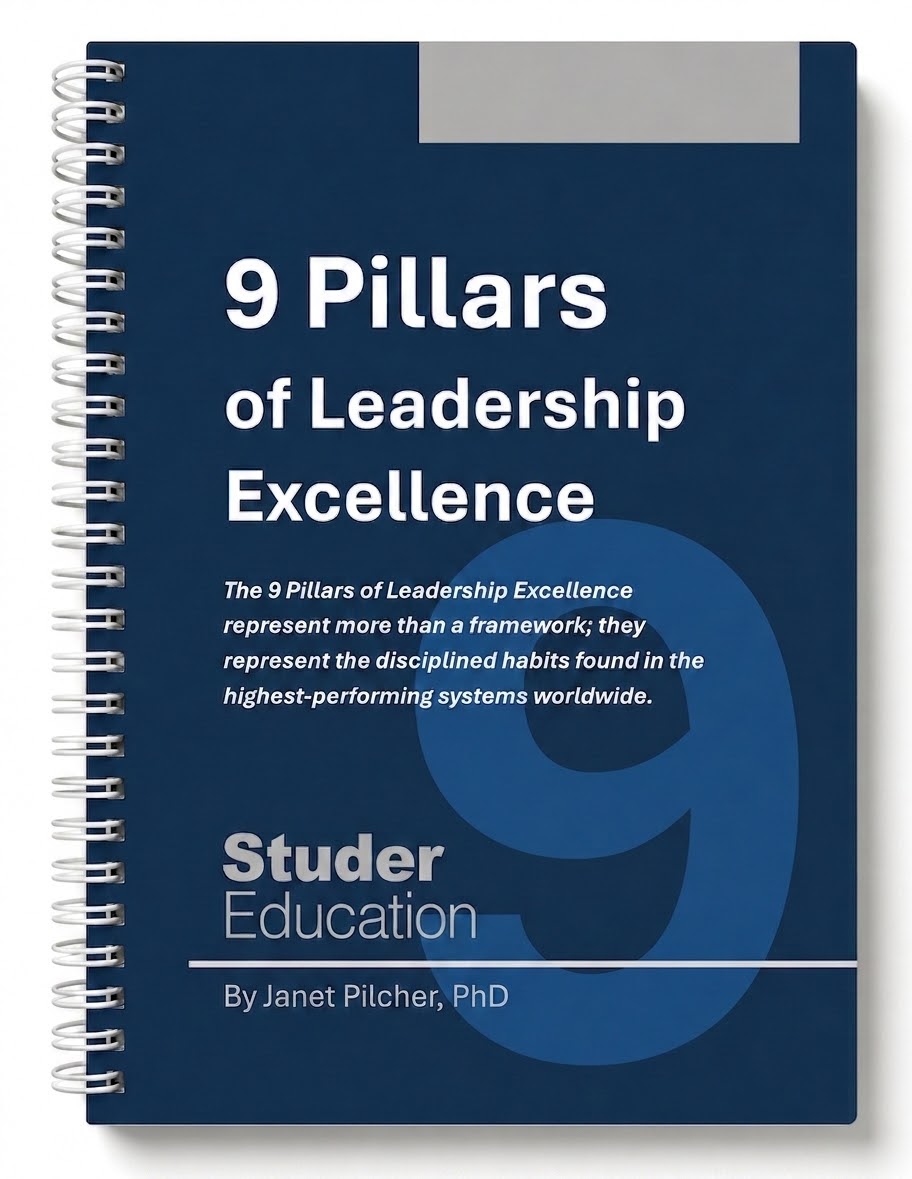
Discover the framework that sustains success. Invite your team to explore the 9 Pillars of Leadership Excellence. Strengthen your district’s capacity with the 90-Day Leadership Engagement Program, utilizing short-cycle improvement planning to turn feedback into definitive action. Take the Leadership Assessment today to begin building the high-performing team your students deserve.
School Leadership Development FAQs
It is the deliberate, ongoing system a district uses to sharpen decision-making, refine administrative skills, and boost organizational efficacy. It relies entirely on intentional daily practices and deeply ingrained operational habits.
Leadership coaching drastically improves rapid decision-making, crisis communication, and problem-solving in real-time. It provides administrators with the specific tools and unwavering support needed to navigate complex, real-world environments.
Continuous feedback empowers leaders to make proactive course corrections immediately. Addressing small adjustments in real-time prevents minor issues from escalating into systemic organizational failures.
Districts build stronger pipelines by embedding coaching, strict accountability, and daily growth conversations into their operational practices. This intentional system guarantees long-term stability and deepens administrative capacity.