

Inheriting a Fractured District
Stepping into a new superintendency often feels like taking the helm of a ship mid-voyage in heavy seas. Community expectations continually test the hull. The crew works tirelessly through demanding conditions. The compass requires constant calibration.
Dr. Jamie Burkhardt faced exactly this scenario. Following a sudden separation in leadership, her district found itself navigating a profound climate shift. Trust across the staff, the board, and the community needed immediate repair. The air in the administrative building carried the weight of uncertainty.
Leaders frequently walk into difficult situations they did not create. Navigating these waters requires immense grace, deep empathy, and unwavering strategic vision. To that end, learning how to build trust in school leadership became Dr. Burkhardt’s immediate mission. She knew that meaningful strategic progress requires people to feel heard and respected.
True school district culture change starts with intentional listening. By prioritizing human connection, she transformed a disconnected community into a unified force for student success.
The Urgent Challenge: Educator Burnout and Why Quick Fixes Fail
OToday, as the Director of Women in Leadership for the Missouri Association of School Administrators (MASA), Dr. Burkhardt sees this localized challenge playing out on a macro scale. The fractured trust she healed in her own district mirrors the broader challenge of teacher burnout driving shortages and administrator turnover nationwide.
Educators pour their sweat and their passion into their classrooms. Yet, the emotional labor required to navigate modern educational demands stretches their capacity to the limit. Over time, the heavy demands of modern education wear on the resilience of our schools.
The data confirms what every superintendent already knows. A June 2026 report from the RAND Corporation found that 55 percent of K-12 public school teachers experience frequent job-related stress, a rate vastly higher than the 34 percent reported by similar working adults. Given these realities, improving school culture and reducing teacher turnover demands immediate, systemic action to support the professionals dedicating their lives to our children.
Why Generic Perks Don’t Improve School Morale
Visionary district leaders operate like chess grandmasters, anticipating the board several moves in advance. Addressing deep-seated organizational fatigue requires systemic transformation. Attempting to cure this level of exhaustion with casual pizza parties is like trying to bail out a sinking ship with a teaspoon. Instead of helping, surface-level gestures gloss over the deep root ache of the workforce. Handing an exhausted teacher a branded coffee mug feels less like appreciation and more like a gentle insult to their intelligence.
As Dr. Burkhardt understands, retention involves creating robust environments where people feel valued, supported, and inspired. Professionals crave genuine connection. They desire crystal clear purpose. Above all, they want a place where they can thrive over the span of a long career.
When you ask educators what actually improves their daily morale, the answers are largely operational:
- Clear, consistent communication from the central office down to the building level.
- Leaders who actively remove bureaucratic barriers that steal instructional time.
- A seat at the table when decisions are made about their classrooms.
- Genuine recognition for the unseen emotional labor they provide to students.
The Core of K-12 Teacher Retention
In a landscape defined by soaring expectations and tightening budgets, building an unshakeable internal culture stands as the premier teacher retention strategy. While district leaders cannot control external factors, they maintain immense power over the internal climate. Mitigating outside pressures requires focusing intensely on the environment inside the building walls. Cultivating an atmosphere of deep respect naturally builds a sturdy vessel capable of navigating external political and financial pressures.
Cultivating an atmosphere of deep respect naturally builds a sturdy vessel capable of navigating external political and financial pressures. When teachers know their leaders have their backs, they stay to chart the course together.
The Foundation: Why Culture Must Precede Strategy
Culture and strategy are inseparable companions on the journey to excellence. They move together in every successful initiative. Still, culture must always confidently lead the way.
Dr. Burkhardt realized she had to pause her strategic initiatives to focus entirely on community healing. Before moving forward, the district required a period of restoration. Going slow to go fast became her guiding philosophy. You must patch the leaks, steady the sails, and support the crew before you can successfully chart a new course.
Improving School District Climate and Culture
Culture serves as the essential operational foundation of any educational organization. A fractured culture will stall the most brilliant strategic plans. Think of it like launching a massive vessel. A million-dollar navigation system means absolutely nothing if the hull is compromised beneath the waterline.
A March 2026 study from the Learning Policy Institute confirms that teachers who experience effective and supportive school leadership are significantly less likely to leave their schools. Dr. Burkhardt knew that repairing this foundation required immense patience, radical visibility, and fierce dedication to the people doing the daily work.
Overcoming the “Us vs. Them” Mentality
Disconnects between the community, the school board, and the building staff create deep divides. A single unaddressed concern can spread quickly through a faculty lounge. To succeed, a unified front requires boldly addressing these fractures before asking anyone to embrace sweeping changes.
The community needs leadership that listens. The staff needs leadership that learns. The board needs leadership that leans in. By actively acknowledging the painful points and bridging the gaps between central office and the classrooms, Dr. Burkhardt began to dissolve the divides that plague so many struggling districts.
The Blueprint: Actionable Steps for School District Culture Change
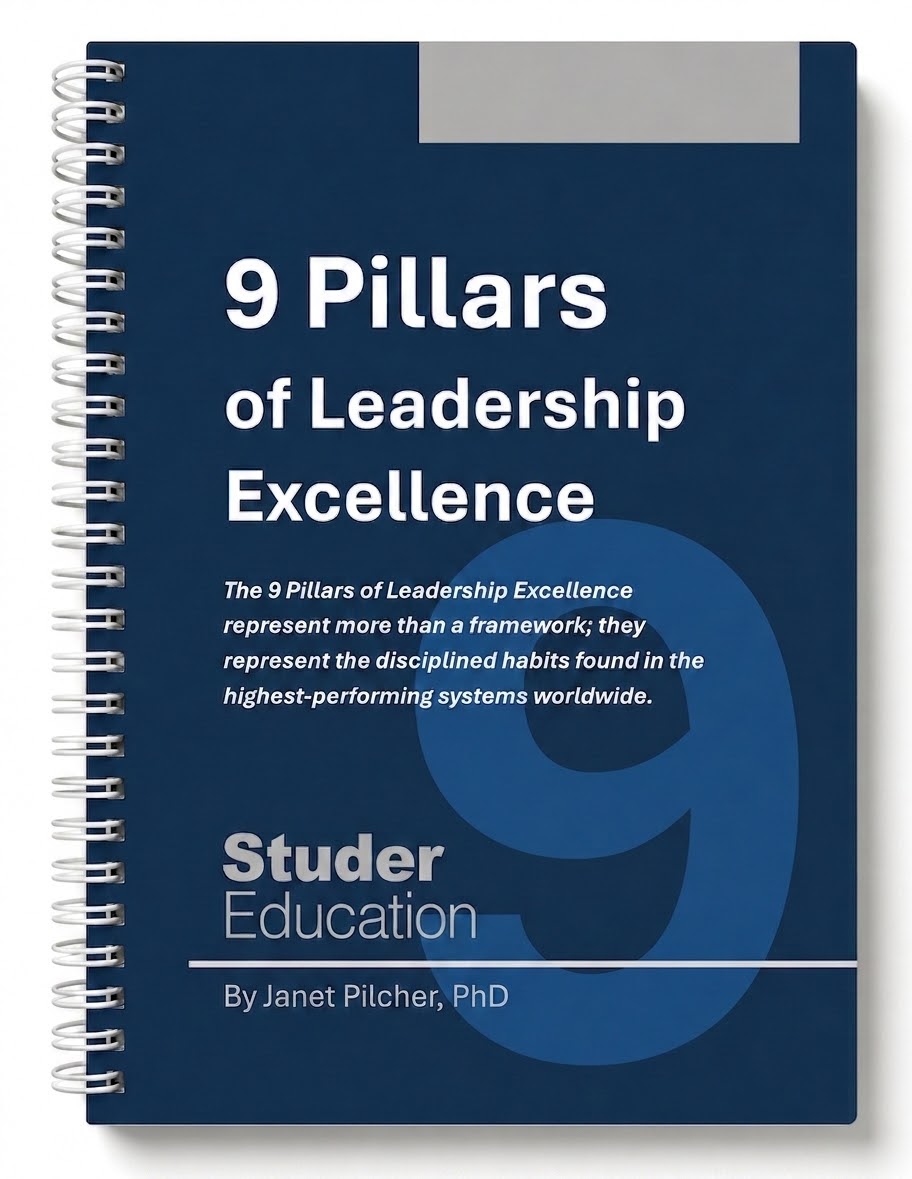
Transforming a district requires specific, highly disciplined processes. To guide this work, Dr. Burkhardt grounded her approach in Studer Education’s 9 Pillars leadership framework. She transformed abstract ideas about culture into concrete, daily leadership behaviors. Taking theoretical frameworks and applying them to everyday interactions creates a rhythm of reliability across the entire school system.
Hardwiring Two-Way Communication in Schools
Surveys provide valuable data, and radical transparency builds enduring trust. Dr. Burkhardt openly shared all survey results with her entire community, bravely admitting exactly where the district fell short of expectations.
This process was far from perfect. When she first published the district’s unvarnished survey data, anxiety spiked. Reading the unfiltered truth about fractured trust on a spreadsheet is deeply uncomfortable. The instinct in leadership is often to hide the data, smooth over the rough edges, and pretend the cracks do not exist. Dr. Burkhardt chose to stand in the discomfort.
That vulnerability acted as sunlight, clearing away the dense fog of suspicion. When leaders share the unfiltered truth about where an organization stands, they warmly invite their teams to become vital co-authors of the solution. Transparency dramatically transforms passive employees into deeply active, engaged problem solvers who take ownership of their collective success.
Rebuilding Relationships with K-12 Leader Rounding
K-12 leader rounding represents a highly structured practice of conducting one-on-one conversations with staff to listen deeply, show gratitude, and identify barriers to success. Taking this to heart, Dr. Burkhardt made a personal commitment to round with every single staff member in her massive district. She walked the halls, sat in the classrooms, and looked her educators in the eye.
During these rounding sessions, she asked a specific set of questions designed to drive immediate action:
- What is working well for you right now?
- Who among your peers deserves recognition for going above and beyond?
- What specific systems or processes are slowing you down?
- Do you have the tools and resources necessary to succeed today?
These rich conversations proved transformative. The simple act of asking and immediately acting on the feedback healed old wounds. Further, it deposited massive amounts of relational wealth into the emotional bank account of the district, proving that leadership is an act of service.
Multiplying Leadership: It’s Not About Having All the Answers
Modern leadership demands building the capacity of others. Dr. Burkhardt champions the philosophy of shared responsibility and collective empowerment. Exceptional leaders purposefully multiply the strengths of their teams and share the heavy burden of solutions. Much like a seasoned captain who equips the crew and then trusts them to hoist the sails and navigate the currents, Dr. Burkhardt empowered her staff to take ownership of the district’s future.
Building Sustainable Leadership Practices
Embedding transparent processes creates a culture that endures long after the current superintendent moves on to new adventures. Eventually, systemic excellence permanently replaces the fragile reliance on a single charismatic leader. When the system itself is structurally healthy, the district can weather any external storm with resilience and grace. Looking ahead, building sustainable leadership practices ensures that unwavering purpose and steady progress remain the district’s driving forces for generations to come.
Empowering Voices and Overcoming Imposter Syndrome
Overcoming imposter syndrome with courage allows aspiring leaders to step into their potential. Imposter syndrome constantly whispers falsehoods in the ears of highly capable professionals, telling them they do not belong in the room. However, courage speaks louder, drowning out the doubt and propelling them forward.
Dr. Burkhardt advises educators to find their trusted mentors and thoughtfully build their professional networks. Current leaders must intentionally tap others on the shoulder to build a strong, resilient leadership pipeline. As proof, her own initiative with MASA started humbly with just five women around a small table. Today, it has grown into an annual summit of over 300 empowered female leaders shaping the landscape of Missouri education. Courage involves stepping forward despite the fear, guided by an unstoppable mission to uplift students, staff, and entire communities.
The Results: When Culture and Strategy Finally Align
The ultimate outcome of Dr. Burkhardt’s tenure serves as a compelling testament to her methods. Because she took the time to build deep trust and clarity early on, her strategic goals achieved profound stickiness. In the end, measurable growth and sustainable success became the new operational standard for the district.
Achieving Continuous Improvement for School Districts
By the time she retired as superintendent, the district had successfully completed the vast majority of its ambitious strategic goals. Her journey proves that culture and strategy relentlessly fuel one another in a continuous loop of organizational health. The district thrived because the people within it thrived. By focusing relentlessly on human capacity, the academic and operational metrics naturally followed an upward trajectory.
Take Action for Your District
Understanding how to build trust in school leadership involves mastering a series of intentional, repeatable behaviors. Any district can adopt this proven blueprint for excellence. You hold the power to transform your organizational climate and inspire your educators to reach incredible new heights. Lasting excellence remains within your grasp, waiting for bold leaders ready to take the first step.
Leadership is a heavy lift. Carrying that weight alone leads to the exact burnout we are trying to cure in our teachers. Transforming a district takes courage, but you do not have to map the journey from scratch.
If your district is ready to prioritize school district operational improvement through a healthy, thriving culture, Studer Education can help. Partner with us to learn how our carefully tailored frameworks and expert K-12 leadership coaching provide the ongoing support leaders need to go slow, go fast, and build an awe-inspiring legacy of unshakeable trust in your community.