

Stepping into the executive office of a university today means inheriting profound complexity. Managing the enrollment cliff operates merely as the baseline of modern administration. You actively fight to prove institutional relevance, absorb the blows of aggressive regulatory oversight, and rally entire academic communities through total technological disruption.
The fatigue is fierce, palpable, and entirely valid. Presidents, Provosts, and Deans face the monumental task of rearchitecting the institution’s foundation while actively bearing the weight of its daily operations. It is akin to renovating the foundation of a historic academic hall while classes remain in full session—the stakes are absolute, and the margin for error is zero.
Yet, you carry the vision and hold the expertise to navigate this era. Institutions that thrive embrace proactive, continuous improvement alongside data-driven decision-making. True leadership inspires action. Bold strategy transforms outdated models. Ultimately, this unwavering dedication ensures your institution endures.
Challenge 1: Navigating Financial Planning and Regulatory Shifts
Navigating the modern minefield of higher education financial planning demands strategic brilliance. The incoming college population is expected to drop by 15% between 2025 and 2029, a staggering demographic shift fueled by the looming enrollment cliff, according to Higher Ed Dive. Evolving regulatory landscapes, strict changes to federal student loan limits, and rigid institutional accountability frameworks bear down on every ledger. Leaders feel the intense scrutiny of compliance while fiercely guarding the fragile ecosystem of institutional health.
Visionary leaders champion sustainable funding models. They cultivate resources that ensure longevity, guaranteeing the institution’s mission outlasts any temporary economic storm. Like a conductor tuning a symphony orchestra to an entirely new frequency, executive leaders must harmonize every disparate department to play the exact same financial chord.
Strategies for Institutional Resilience
True institutional resilience requires melting deeply entrenched bureaucratic boundaries to forge a fluid, unified financial ecosystem. Cross-departmental collaboration pools intellect to serve the greater mission.
Empowering Deans with adaptive leadership strategies grants them the autonomy to manage departmental budgets creatively. We shape the culture, and the culture shapes us. Fostering financial agility at the decanal level turns the entire university into a masterclass in resilience, ensuring that every dollar spent acts as a direct investment in the institution’s legacy.
Challenge 2: Transitioning from AI Adoption to AI Governance
Artificial intelligence remains a permanent, structural reality in academia. The dialogue must advance beyond merely policing academic integrity to fundamentally reshaping institutional operations. Organization-wide AI adoption recently jumped to 66%, according to recent industry data, yet only 43% of institutions successfully embed AI governance into their strategic plans. This exposes a dangerous gap.
Compounding this risk is a massive disconnect in perception; HR Dive reports that 78% of higher education leaders believe they meet employer expectations regarding AI skills, but a mere 28% of employers agree. Furthermore, only 14% of current graduates feel they possess high-level proficiency in applying AI tools professionally, even as job postings requiring generative AI skills for nontechnical roles have grown ninefold. Technology possesses the raw power to elevate human potential, provided a steady hand guides it.
Building a Culture of Trust in Digital Transformation
Authoritarian technological mandates consistently fail. When faculty and staff help design the digital roadmap, they own the journey. We cultivate institutional trust building by prioritizing transparent, data-driven decision-making.
Trust remains the ultimate currency in higher education. Faculty buy-in flourishes when executive leaders prove that digital transformation serves the academic mission. Honor the expertise of educators. Implement systems that support their pedagogical goals. Value your people, and they will champion the tools that propel the institution forward.
Challenge 3: Closing the Relevance Gap and Elevating Student Success
Communities, families, and industries passionately demand proof of the return on investment in higher education. Despite persistent cost concerns, nearly 8 in 10 families still see college as a highly worthwhile investment, according to a Prospective Family Survey by Higher Ed Dive. However, the exact same survey reveals a critical vulnerability; while 94% of parents say information on graduates finding jobs is imperative, 68% report they cannot locate these data.
The public yearns for institutions to actively close the skills gap in the undergraduate curriculum. They demand robust workforce education. Today, 43% of college graduates find themselves underemployed in their first job, and just one-quarter of working Americans say their education is relevant to their work life. Students dream of stepping across the graduation stage equipped with the exact competencies the modern world requires.
Maturing Leadership Teams to Drive Improvement
Student success requires a deeply unified front. The most spectacular triumphs in higher education occur when leadership teams operate in total harmony. Executive teams foster next-gen student belonging and retention by actively aligning academic affairs, student services, and financial aid.
Consider the Organizational Flywheel concept. At its core lies purpose, worthwhile work, and making a difference. When academic advisors, financial aid officers, and faculty members operate from this unified center, students experience a flawless web of support. We create inspiring workplaces, build strength in our people, and accelerate results.
Moving from Strategy to Execution: The Continuous Improvement Framework
The weight of the presidency, the provost’s office, or the dean’s chair is notoriously isolating. You are expected to hold the answers, bear the risks, and chart the course. True institutional maturity requires recognizing that the burden of execution should never be carried alone.
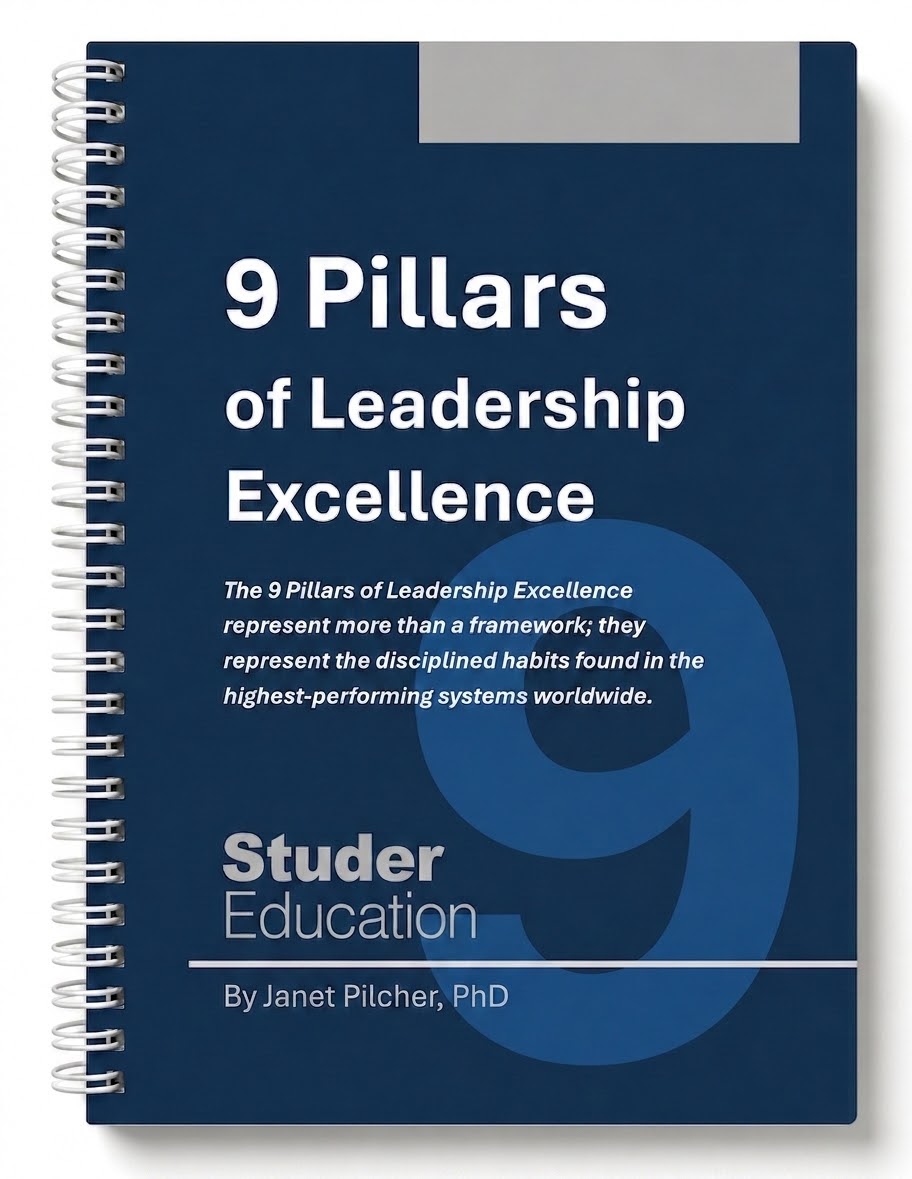
To move from high-level strategy to deeply rooted execution, leadership teams must anchor themselves in a shared, continuous improvement framework. The 9 Pillars of Leadership Excellence provide the definitive blueprint for this execution. Committing to excellence and building a culture around service transforms organizational health. Visionary leaders like Dr. Natalie Harder at Coker University and Dr. Vincent June at South Louisiana Community College prove that hardwiring these behaviors leaves a legacy of positive impact.
Legendary college football coach Nick Saban frequently asks his teams, “What’s important now?” He focuses on executing the immediate process with absolute fidelity to achieve ultimate victory. We must apply this exact continuous improvement mindset to higher education. Developing leaders to develop people positively shifts the results curve, moving performance up and to the right.
Join Us at Destination High Performance: Higher Education
Every year, the nation’s most forward-thinking academic leaders make a quiet exodus. They step away from the relentless demands of campus to recalibrate, reconnect, and refine these exact frameworks alongside peers who implicitly understand the weight of the crown.
We invite you to gather with the brightest minds in academia to recharge your passion, purpose, and performance at the annual Destination High Performance (DHP) Leadership Conference.
Event Details at a Glance:
- Dates: June 2–3, 2026
- Location: Hilton Pensacola Beach, FL
- Focus: Driving Improvement and Achieving Excellence in Higher Education
Expect unparalleled deliverables designed specifically for executive leaders:
- Expert-led panels on executive leadership and cross-disciplinary financial ecosystems.
- Interactive sessions on data-driven decision-making and workforce education.
- Unmatched networking with higher education leaders from across the country.
Space is highly limited, and early hotel booking at the Pensacola Beach Hilton ends May 14, 2026. Secure your spot today to learn, connect, and lead with monumental impact.