

The exact weight of the leadership chair is undeniable. Navigating board politics, weathering budget storms, and carrying the immense, beautiful responsibility of guiding a community’s children toward a better future requires extraordinary resilience. Education leaders today operate as front-office executives, public relations directors, and instructional visionaries all at once. Armed with extensive education and a deep research background, your relentless drive already positions you for success.
What you demand is a highly actionable system that translates your strategic vision into daily reality.
There is a frustrating, familiar gap between the brilliant five-year strategic plan sitting on your shelf and the chaotic reality of a Tuesday morning in the central office. Bridging that gap requires more than sheer willpower. It requires a leadership operating system. Without one, your district is essentially a highly skilled orchestra trying to play a symphony without sheet music.
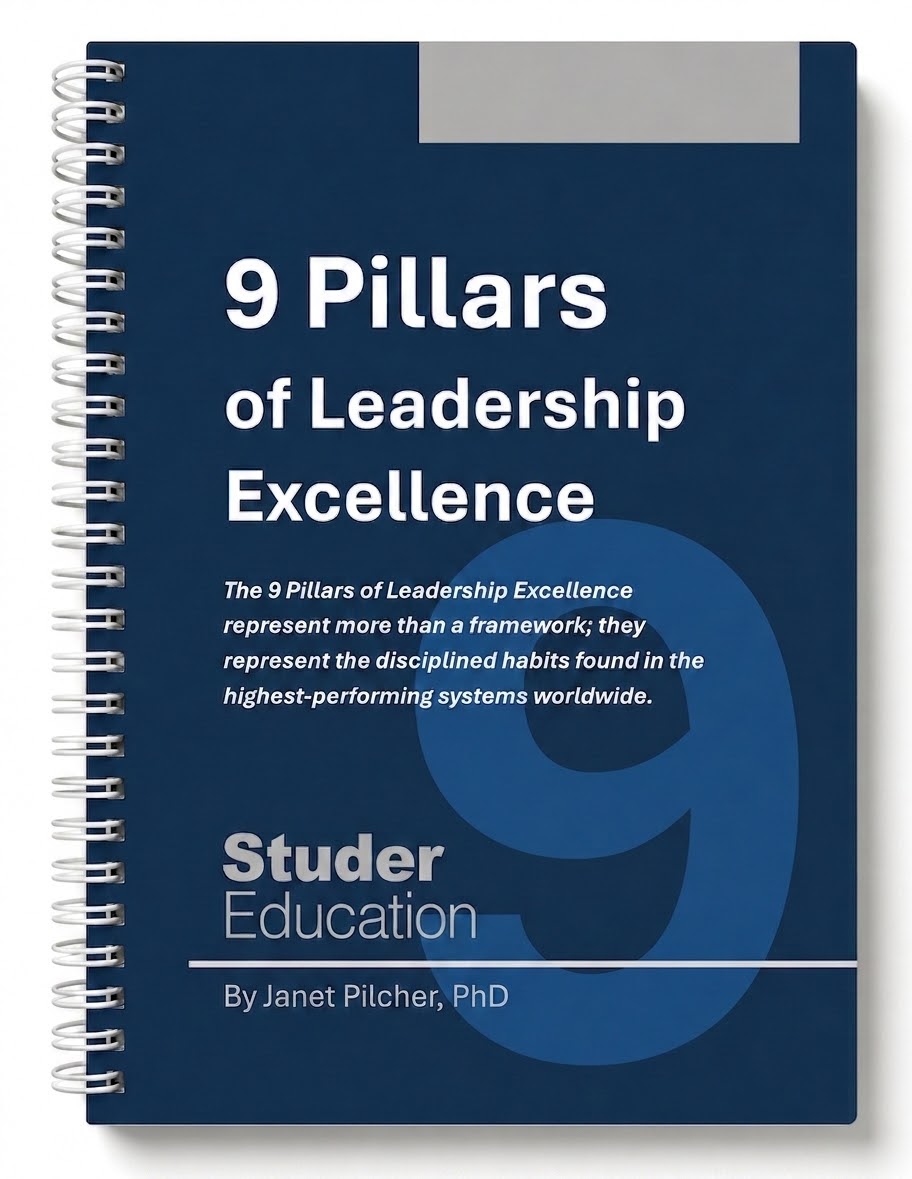
The 9 Pillars of Leadership Excellence Desk Reference Guide is Studer Education’s practical leadership operating system. It was specifically designed to embed consistent leadership behaviors across schools, departments, and districts. This complete, practice-ready Desk Reference Guide provides the precise resources and digital tools required to strengthen leadership clarity, culture, and execution.
Let’s open the guide.
The Challenge of Strategic Alignment in K-12
If you have spent any time reading the 2025 American Superintendent Study from AASA (The School Superintendents Association), you know that the modern superintendent is now fundamentally a civic leader. You navigate political noise, build community coalitions, and try to keep your staff from burning out. AASA emphasizes that a strong relationship exists between effective improvement practices and high performance, but it demands leaders committed to authentic culture, not quick fixes.
You plan for excellence, equity, and achievement. Yet, improving school district culture and expanding leadership capacity often stalls. Why? Because the friction of execution slows everything down.
A principal in one building might run highly effective, data-driven meetings, while a department head across town struggles to keep their team focused. This fragmentation happens because leadership excellence demands deliberate daily behaviors to build culture and deliver outcomes. When those daily behaviors aren’t standardized, execution becomes wildly inconsistent.
Sustainable improvement is built through shared leadership practices, disciplined routines, and behaviors embedded in daily work. You cannot simply command a culture into existence, mandate morale, or legislate loyalty. Building an unbreakable district culture mirrors the precise engineering of a massive suspension bridge. The structural integrity relies entirely on the invisible tension of countless intertwined steel cables carrying the tremendous weight together. In your K-12 ecosystem, those load-bearing cables are the micro-decisions, the deliberate daily interactions, and the uncompromising standards your leadership team upholds.
Exploring the 9 Pillars Desk Reference Guide: A District-Wide Leadership System
The defining characteristic of the 9 Pillars is their absolute permanence. The 9 Pillars represent a complete leadership operating system engineered to outlast any single strategic cycle. This framework hardwires excellence so deeply into your daily routines that it becomes the permanent, unshakeable foundation of your district’s culture.
When you open the spiral-bound guide, you are looking at a continuous improvement framework for districts that anchors your strategy in reality. It functions as both a districtwide leadership system and a standalone resource for individual schools, supporting alignment across roles while allowing flexibility.
The foundation of this system rests on 9 uncompromising pillars:
- Pillar 1: Aim High to Achieve Excellence. Set high expectations to achieve results while living out mission and values.
- Pillar 2: Measure What’s Important. Drive key strategic actions and progress measures to achieve important outcomes.
- Pillar 3: Communicate for Alignment. Show how individual roles align to a shared vision and clear goals.
- Pillar 4: Recognize the Bright Spots. Recognize and celebrate what’s working.
- Pillar 5: Value Employees to Show They Matter. Cultivate a positive, supportive, and trusting work environment where employee contributions are valued, recognized, and celebrated.
- Pillar 6: Exceed Customer Expectations. Serve others with great care and concern. Create positive, memorable experiences that lead to increased customer loyalty and satisfaction.
- Pillar 7: Align Goals, Behaviors, and Processes. Apply an execution framework to implement a system for continuous feedback to help teams stay on track and adapt as needed.
- Pillar 8: Develop People to Improve and Perform. Develop people to achieve positive results and high performance.
- Pillar 9: Continuously Improve to Achieve Success. Lead with an improvement mindset, scaling accomplishments, facing challenges as learning opportunities, and building a sustainable system.
What’s Inside? Breaking Down the Resources
The 9 Pillars Desk Reference Guide includes tools, tactics, and guidebooks in addition to access to Studer Education’s Online Leadership Library. This is where theory meets the pavement.
The Spiral-Bound Desk Reference Guide
This physical manual contains the core content, lessons, tactics, questions, tools, and supporting resources designed to prompt thoughtful reflection, structured discussion, and executive cabinet dialogue focused on real leadership challenges. They operationalize values to define workplace expectations.
The Online 9 Pillars Reference Library
Every 9 Pillars Book purchased includes one year of access to the Studer Online leadership library. This robust digital platform gives you immediate access to:
- Supplemental Study Guides and Book Studies for each Pillar
- Facilitator Guides for running collaborative leadership workshops
- Leadership Execution Tactics and Improvement Worksheets
- Process Improvement Tools and Resource Templates to solve complex problems
- Case Studies and Online Learning Courses to reinforce continuous development
Transforming Meetings into Working Sessions
Let’s be incredibly honest. Most administrative meetings are passive status updates that could have been an email. Time is the one asset you cannot replenish. Education leaders desperately need to shift from passive listening to active problem-solving.
The 9 Pillars are designed to support intentional, action-oriented leadership conversations that move beyond reflection to execution.
Instead of sitting around a mahogany table reviewing last month’s lagging indicators, use the supplemental tools and exercises as working sessions where leaders identify process improvement opportunities, test change, and map next steps with tangible and measurable action plans. Each Pillar is intentionally designed as a working session to empower leaders with the tools and information they need to lead activities and change with process and clear action steps aligned to district priorities.
Picture your next cabinet meeting. Your team actively digs into the details to determine the behaviors and actions that lead to success. They engage in conversations about lessons learned from the bright spots to encourage more people to adopt them. You spend time on what truly matters and stop doing things that don’t. This sets the stage for engaging in improvement conversations that focus on what’s working and what’s not.
By doing this, measuring what matters in education stops being a catchphrase and becomes a disciplined, weekly reality.
Building Your Measurable Action Plan
A powerful vision demands a precise timeline to become reality. The ultimate payoff of the 9 Pillars Desk Reference Guide is a concrete, unified blueprint for execution.
Through the planning, implementation, and monitoring of the 9 Pillars, leaders can consistently anchor improvement activities in actual roles, departments, schools, and systems, ensuring conversations translate into practical improvements.. The execution tactics in the box culminate in rigorous 30, 60, and 90-day action plans.
You learn to apply feedback loops as a habit of practice. You review progress measures and aligned actions periodically to determine areas to adopt, adapt, or abandon. Using the Desk Reference Guide consistently enables districts to build a shared leadership language, align leadership behaviors to organizational goals, and strengthen disciplined improvement efforts. It makes leadership expectations visible in daily work.
The Next Step in Hardwiring Excellence in Education
Hardwiring excellence in education requires deliberate practice, thick skin, and the absolute best tools available. You already have the vision to lead your district into its next great chapter. You already know what excellence looks like. Now, equip your people with the system they need to execute that vision every single day.
Lead the system, so the system doesn’t lead you.
Ready to bring these powerful, ready-to-use leadership exercises to your next cabinet meeting? Order the 9 Pillars Desk Reference Guide today to turn your strategic vision into measurable, unstoppable momentum.