

Vision starts at the cabinet level and culture flows directly from your central office. Translating that overarching strategy into daily, reliable execution through continuous improvement in education is the defining challenge of modern district leadership. Often, an initiative launches with immense fanfare in August, yet fades quietly into the background by October. As a result, initiative fatigue sets in, execution varies wildly across campuses, and accountability systems feel disconnected from the daily reality of the classroom.
To combat this inconsistency, leaders must apply strategies on an ongoing basis to identify areas for improvement and use feedback to make small, incremental changes. Sustainable change demands a comprehensive strategic alignment and execution framework. When daily efforts, processes, resources, and people align perfectly with overarching organizational goals, districts transform. Ahead, we explore how mastering organizational alignment, leadership accountability, and process improvement builds an enduring legacy of excellence.
What Is Continuous Improvement in Education?
At its core, continuous improvement operates as a relentless, enduring operational discipline. You build the strategy. The team executes the plan, and together, you adjust the systems. This formative work relies heavily on assuming there is always room for improvement and refinement based on feedback and data.
In practice, focused continuous improvement actively reduces the “hassle” across the district. Hassle refers to the specific barriers people face that prevent them from doing their job efficiently and effectively. Left unchecked, hassle leads directly to deep frustration and stress in the workplace. By aligning all efforts and holding people accountable, leaders reduce this hassle, positioning their organizations to improve, succeed, and maintain a positive culture. In the end, every ounce of effort poured into the district must yield a tangible, lasting impact on student achievement.
Why Do School Improvement Efforts Often Stall?
Frequently, improvement efforts lose momentum because disconnected systems fracture focus and dilute energy. Achieving sustained organizational excellence is directly tied to a leader’s ability to balance the interplay between individual capability and system capacity. Individual capability refers to a person’s potential to apply necessary skills, knowledge, and talent. On the operational side, system capacity depends heavily on the organization’s ability to align efforts, consistently meet expectations across teams, and deliver quality outcomes in repeatable and reliable ways.
Severe barriers emerge when individual capability and system capacity are mismatched. Highly skilled professionals become deeply frustrated by inefficient systems. Conversely, efficient systems become gridlocked bottlenecks due to a deficit in skilled talent. For this reason, initiative fatigue signals a desperate need for structural alignment. By building strong, connected systems, you guarantee your strategic vision takes root in every single classroom.
How Does Organizational Alignment Support School Improvement?
Fundamentally, organizational alignment ensures everyone in the organization works together toward the same goals and applies the expected behaviors to achieve those goals. Misalignment exacts a heavy toll. Picture a chaotic environment with arrows pointing in all directions, representing a complete lack of unified strategy. Even with phenomenal talent in the building, execution falls flat.
Fortunately, alignment brings breathtaking clarity, seamless consistency, and powerful execution. Once an organization establishes a clear strategic direction, those individual arrows move in the exact same direction and in sync with the large overarching goal. To achieve this, alignment must scale top-to-bottom. Leaders shape the systems, and the systems shape the leaders. Acting as a guide, the leadership execution framework helps leaders manage this exact intersection, ensuring the organizational vision, goals, behaviors, and processes are entirely aligned.
What Does Leadership Accountability Look Like in High-Performing Districts?
In action, healthy accountability is the active, daily commitment to owning outcomes and proactively removing barriers for your team. The execution framework breaks this vital work down into three broad categories: Aligned Goals, Aligned Behaviors, and Aligned Processes.
Alignment occurs simultaneously across and within goals, behaviors, and processes. First, in aligned goals, defined performance measures track results on key priorities. Next, in aligned behaviors, human-performance expectations are clearly defined, and leadership behaviors are consistently applied by all leaders. Finally, in aligned processes, leaders monitor organizational progress and allocate resources in responsible and strategic ways.
This evidence-based approach significantly reduces the risk of investing time and money in inefficient practices, thereby strengthening employee trust. From there, cascading accountability transforms the entire culture, shifting the conversation toward fixing the system together.
How Do District Leaders Use Process Improvement to Reduce Organizational Friction?
Process improvement is a systematic method to simplify operations, reduce inefficiencies, and boost cross-team execution. These tools give you a highly structured way to implement solutions and solve problems. Direct your attention toward the operational friction. By identifying the underlying systemic flaws, you ultimately free your faculty to focus on what matters most.
To accomplish this, district leaders identify operational barriers by utilizing root cause analysis tools to distinguish between the immediate symptom and the fundamental issues causing the problem. The “5 whys” is a simple yet powerful tool used to quickly get past the symptoms of a problem to the underlying cause by iteratively asking “why.”
Additionally, teams use a fishbone diagram, a visual tool resembling a fish skeleton, to look beyond surface-level symptoms to identify underlying causes. Furthermore, process maps provide visual diagrams of step-by-step workflows to uncover missing steps, redundancies, and points of gridlock. Smoothing out operational bumps protects your educators’ precious time and energy.
Why Short Improvement Cycles Create More Sustainable Change
Historically, large-scale efforts lose steam when districts wait until the end of the academic year to review progress. Instead, speed and rhythm keep the heartbeat of organizational change strong, visible, and highly adaptable. Leaders guide their teams to achieve 90-day measurable goals by laying out distinct weekly priorities and actions. Since every day of a quarterly cycle is absolutely critical, leaders design quarterly plans that map a clear path for achieving critical goals.
As part of the short-cycle review, leaders engage teams in time-bound sprints, typically lasting one to four weeks, to complete a set amount of work within a specific time frame. Think of sprints like a road map embodying the metaphor of the elephant and the rider. The leader guides the team down the path, while the team executes the work and provides the power. Throughout the journey, applying a stoplight process—using green for on track, yellow for making progress, and red for off track—provides instant clarity on status and risk.
When an intense and complex problem surfaces, the process shifts to an intervention using improvement huddles. Improvement huddles are brief, 15-minute structured team meetings focused on continuous improvement and problem-solving. This dynamic rhythm keeps the entire district energized, engaged, and moving relentlessly forward.
What Is the Role of Feedback Loops in Continuous School Improvement?
Equally important, feedback loops act as the central nervous system of any successful district. They provide a mechanism for iterative learning and refinement, allowing people to modify behaviors based on new information. This process occurs through a methodical cycle of gathering data, analyzing data, making sense of the discoveries, and acting on the data.
This constant, formative work heavily influences the overall summative results and annual measurable goals on the organizational scorecard. When stakeholders see their feedback transforming directly into systemic change, they invest deeply in the district’s long-term vision. They evolve from passive participants to active co-creators of your district’s success. Institutionalizing these loops ensures your central office remains deeply connected to the reality of the classroom.
How Studer Education Helps Districts Build Systems for Continuous Improvement
Transforming a district requires laser focus and fiercely aligned systems. Pillar 7 introduces a collective, comprehensive strategic alignment and execution framework. Studer Education serves as your trusted partner, helping you build the robust systems that support aligned leadership practices and sustained execution.
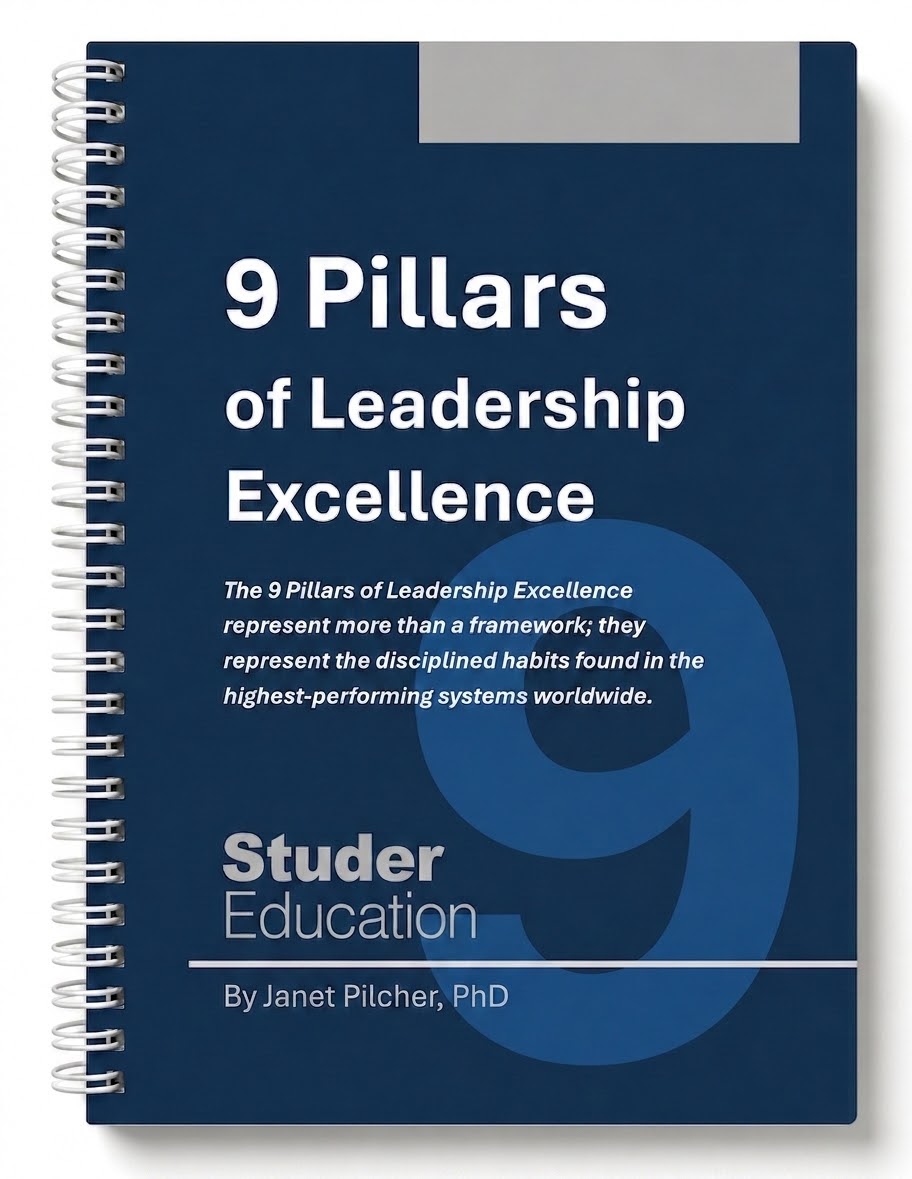
Take the next step by exploring the 9 Pillars of Leadership Excellence to discover how to identify areas for improvement and assume there is always room for refinement based on feedback and data. Discover how structured cycles help strengthen accountability and turn feedback into action through our 90-Day Leadership Engagement Program. To begin, gauge your current alignment today with our Leadership Assessment.
Continuous Improvement in Education FAQs
Continuous improvement in education involves applying strategies on an ongoing basis to identify areas for improvement and using feedback to make small, incremental changes.
Efforts stall because the mismatch between individual capability and system capacity create barriers. Highly skilled people become frustrated by inefficient systems.
Organizational alignment ensures everyone in the organization works together toward the same goals and applies the expected behaviors to achieve those goals.
Districts improve accountability by tracking results on key priorities, applying consistent leadership behaviors, and allocating resources in responsible, strategic ways.
Short cycles guide teams to achieve 90-day measurable goals by laying out weekly priorities and actions, keeping teams aligned and focused on the right work.
Feedback loops provide a mechanism for iterative learning and refinement, allowing people to modify behaviors based on new information until they achieve a desired outcome.