

As a school district leader, the weight of the future sits squarely on your desk every single morning.
Meaningful strategic planning in education is exactly how you carry that weight and drive systemic change. Yet, as you navigate leadership transitions and the deeply entrenched friction of institutional inertia, you likely face the silent crisis of initiative fatigue. Brilliant, well-meaning programs launch with grand fanfare, fading away quietly before anyone measures their true impact.
The data validates this profound frustration: landmark research from Bain & Company reveals that while 90% of organizations develop detailed strategic plans, nearly 88% fail to achieve their intended targets. A robust district strategic plan completely defies those daunting odds. It transcends the “binder on the shelf” syndrome, acting as the beating heart of your organization, pumping clarity and purpose into every classroom, cafeteria, and central office boardroom.
Strategic planning is the collaborative process of involving multiple stakeholders to improve outcomes. Vision serves as your ultimate destination. Strategy functions as the steady, purposeful engine driving you there. Leaders who embrace a bold, unapologetic direction generate immediate momentum, escaping the slow decay of the status quo. Strong districts build sustaining systems. They implement rigorous rhythms of review, transparent data dashboards, and continuous feedback loops that keep the plan breathing long after the initial planning sessions end.
What Makes a Strong Strategic Vision for a School District?
A strong strategic vision is a clear, highly aspirational statement defining organizational success five years into the future, outlining key levers for how you will get there. Brilliant visions demand measurable direction. They capture the raw, human element of education while reflecting critical future trends: rigorous workforce preparation, comprehensive student well-being, and shifting family expectations.
Vague, watered-down visions fail completely. A vision statement applying universally to any random district in the state severely lacks the specific DNA required to drive localized change. A powerful vision offers a touchstone and a ‘why’ to drive total commitment. Consider the power of these concrete, deeply specific statements:
- “Every graduate leaves our doors biliterate, financially literate, and exceptionally prepared for the global workforce.”
- “We create environments where students are inspired to be creative and critical thinkers as they prepare for success in life, college, and career.”
- “We build relationships with students to honor their cultural heritage, foster their physical, social, and emotional well-being.”

How Do District Leaders Set Bold but Achievable Goals??
Leaders set bold goals by identifying precise stretch targets that demand a departure from comfort zones, remaining firmly grounded in the district’s actual capacity and baseline data.
You must find the “difficult but possible” sweet spot. When you set audacious goals, like becoming a premier, award-winning school district, you instantly generate immense cultural energy. You attract top-tier educators who want to play for a winning team. Think of Billy Beane in Moneyball, rejecting old, tired metrics and setting a completely new standard for how success is measured and achieved. You have the power to redefine the metrics of success for your children.
Goal setting requires relentless, cascading alignment and synergy with your School Board. A superintendent’s strategic plan lives or dies by the Board of Education. Engaging your district leadership and the Board early ensures that your boldest goals reflect the community’s deepest values.
Once aligned at the governance level, an overarching district strategic plan must connect to the daily classroom experience. Individual school improvement plans deliberately align with the district’s big aims. You connect grade-level goals, classroom goals, and ultimately individual student goals directly to the district scorecard. This cascading alignment ensures every single daily action drives collective success and moves the entire district forward.
What Is the Process for Strategic Planning in Education?
The strategic planning process involves a multi-phase cycle of passionate stakeholder engagement, honest data analysis, courageous priority setting, and intentional communications.
- Envision and Anchor: A five-year scope defines a clear, stable vision for success. It provides enough runway for meaningful transformation while remaining urgent enough to demand immediate action.
- Gather and Analyze: You must dig into the reality of your current state. Conduct environmental scans, administer rigorous surveys, and host focus groups with teachers, parents, and students to analyze input and generate themes.
- Listen and Align: Establish a cross-functional advisory group. This team serves as the champions and course correctors of the entire process, honoring community input while driving the work forward . Hold initial board meetings to define the scope and maintain transparent communication with board members so there are no surprises when it is time for final approval.
- Focus and Prioritize: Plans collapse under the crushing weight of too many priorities. An effective strategic plan for a school district focuses on a few specific areas to drive the absolute greatest leverage for improvement. Embrace the vital few over the trivial many.
- Translate and Act: Strategy dictates your boundaries. The priorities you select determine exactly how you achieve excellence.
How Do You Turn Core Values Into Everyday Behaviors?
Values become observable, undeniable behaviors when leaders explicitly define, passionately model, and deeply integrate them into hiring, evaluation, and recognition systems.
Human interactions dictate culture. In the hit show The Bear, the restaurant staff works under a sign reading “Every Second Counts.” That phrase operates as a value entirely operationalized into the intense, daily rhythm of their work. If Compassion or Integrity are your core values, you must operationalize them. Define exactly what compassion looks like during a highly tense, emotionally charged school board meeting. Define what integrity looks like when a principal reviews lagging test scores with a struggling first-year teacher.
Standardizing these behavioral expectations significantly reduces the “zip code lottery.” You ensure every student, parent, and staff member experiences the exact same high-quality, supportive environment regardless of which campus they attend. Consistent behaviors build unbreakable, lifelong trust.
Why Do Strategic Plans Fail for K-12 Districts?
Most strategic plans fail due to a severe, festering “we/they” disconnect between the central office and the classroom, compounded by a lack of disciplined follow-through and poor district leadership habits. Capable, caring leaders often fall into the trap of “rescuing” teams by jumping in to fix problems directly. You build monumental capacity by coaching your teams to solve problems independently.
Furthermore, a district’s strategic plan must secure deep emotional buy-in. A plan can look perfectly rational on a spreadsheet; however, if the staff feels alienated from the creation process, execution stalls immediately. People passionately support what they help create. Strategic planning provides a profound opportunity to build cohesion and cultural affinity; making people feel informed, engaged, and respected is a vital performance outcome in itself .
Plans also fail because leaders let them quietly fizzle out. When a strategic plan reaches the end of its lifespan, institutions rarely wrap them up properly. You must close a district’s strategic plan with great fanfare, going big with publicity, detailing exactly what was accomplished, and transparently explaining what fell short . Acknowledge the critics, listen to the concerns, and use those lessons to bridge the gap into your next bold vision . Execution discipline and cultural heartbeat must synchronize perfectly.
How Studer Education Helps Districts Aim Higher and Execute with Clarity
You possess the vision, the intellect, and the profound dedication to transform your district. But transforming a district requires deep, sustained capacity building. Studer Education partners with organizations across the country to support system-wide continuous improvement and performance excellence. We serve as your capacity-building partner, bridging the frustrating gap between a brilliant plan and high-quality, sustainable execution.
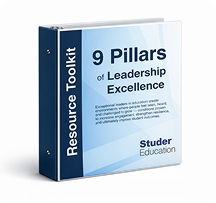
By coaching your existing leaders—partnering with our team of former superintendents, principals, and district-level academic leaders—we help you address the friction of misalignment and initiative fatigue head-on. The 9 Pillars of Leadership Excellence provides a proven, actionable roadmap, ensuring your strategic priorities translate directly into measurable student success and robust organizational health. We support continuous cultural improvement and the execution of your boldest goals.
Connect with our team to discuss your district’s unique needs and discover how to aim higher.
Strategic Planning in Education FAQs
A highly effective strategic plan typically defines organizational success and outlines a clear, bold vision for five years from its creation.
The process requires input from diverse stakeholder groups to guarantee deep inclusivity. This includes internal and external focus groups comprising executive leaders, classified staff, teachers, parents, students, business leaders, and community partners.
A vision statement defines the ultimate definition of organizational success five years from now. The strategic plan encompasses that vision alongside the specific, prioritized strategies, overarching goals, and core values required to achieve it.
You secure undeniable buy-in by making the strategic planning process fiercely collaborative. Engage internal stakeholders through focus groups and surveys, ensuring their voices actively shape the current assessment and future priorities. When educators and community members see their exact fingerprints on the final plan, they invest emotionally and fully in its success.