

Superintendents and principals face a daily whirlwind of competing priorities, shifting mandates, and the heavy burden of initiative fatigue. Sustaining genuine, long-lasting improvement requires moving beyond isolated strategic plans to build deeply ingrained habits. The most successful education professionals know that enduring trust demands consistent routines, clear communication, and deliberate action.
Effective school leadership empowers executives to intentionally model the exact behaviors, priorities, and improvement habits they expect to see across the organization. This guide explores actionable strategies for setting measurable goals, aligning workplace culture, and driving sustainable improvement that outlasts any single school year.
What Is Effective School Leadership?
Effective school leadership acts as a deliberate system of repeatable practices and behaviors that continuously shape district culture. By constructing these intentional frameworks, exceptional administrators cultivate environments where educators thrive and students consistently succeed. Because this level of visionary leadership demands perseverance, humility, and an active improvement mindset, superintendents and principals anchor their daily routines in these core principles. This steady alignment guarantees that every executive decision ultimately drives student achievement.
Clear strategic planning drives deliberate daily routines, ensuring that initial visions reliably transform into outstanding district-wide results. By viewing inevitable setbacks as growth opportunities, these professionals build resilient, adaptable school systems capable of weathering any challenge. Maintaining this improvement mindset requires daily dedication, meticulous prioritization, and intentional action.
Why Effective Leadership in Schools Starts With Modeling the Right Behaviors
Effective leadership in schools begins with modeling the right behaviors because executives establish the cultural baseline for attitudes and expectations across the entire district. When leaders actively demonstrate the standards they expect, those precise actions cascade organically down to every classroom, department, and hallway.
The stakes for this visibility are incredibly high. A March 2026 RAND report notes that while national educator turnover has stabilized since the pandemic peaks, principal turnover still hovered around 8.2% during the 2024-2025 school year, remaining above pre-pandemic levels. This churn is deeply destabilizing. According to a 2026 report by the Office of the State Superintendent of Education, teacher retention dropped by 5 percentage points in schools that experienced principal turnover the previous year.
Superintendents mandate morale by modeling it. Principals demand dedication by demonstrating it. Excellent leaders are exemplary role models; they lead by example, exhibiting the desired behaviors and standards they expect from their teams. They do what they expect others to do, willingly working alongside their teams to achieve measurable goals. Ultimately, a district does not merely adopt a leader’s vision; it adopts a leader’s habits.
How School Leaders Build Trust Through Purpose, Communication, and Consistency
School leaders build trust by communicating clearly, connecting daily work to a higher organizational purpose, and demonstrating unwavering consistency in their decisions. When leaders communicate with clarity, educators respond with conviction. When leaders operate with consistency, teams execute with confidence.
District leaders must explain the deeper purpose behind the work, especially when asking teams to adapt to change. While education leaders are currently bombarded with ed-tech and AI solutions, 2026 research into educational trends shows that effective leadership requires a steadfast commitment to wellness and human connection. Leaders who successfully integrate innovation without losing the “relational core of learning” see better academic outcomes and reduced staff burnout.
Connecting daily tasks to a higher purpose, the worthwhile work of making a difference in the lives of students, retains passionate educators and keeps the organizational fire burning. Consistency reduces confusion. It fosters a profoundly healthier school culture. When executives show genuine care for the people executing the vision, compliance transforms into deep dedication. Leaders start this critical work by intentionally building a strong emotional bank account with their teams.
Why Must Culture and Strategy Work Together in Effective School Leadership?
Culture and strategy must coexist seamlessly because a supportive culture is the engine that drives the successful execution of a strategic plan. Leaders connect high-level strategic priorities to daily leadership actions, team behaviors, and measurable outcomes. To continuously improve, culture and strategy must go hand in hand. Culture itself hinges on the degree to which leaders’ and employees’ behaviors align with organizational values and goals.
Strategy provides the map. Culture provides the fuel.
This alignment acts as a profound equity strategy, proving that culture isn’t just “fluff.” A May 2026 report from the Learning Policy Institute confirms that principal turnover is associated with declines in student test scores, with the heaviest impacts falling on high-poverty schools. Conversely, when effective principals create positive school climates, test scores, grades, and student engagement rise, reducing the negative effects of poverty on achievement. Even the most brilliantly designed blueprint will fail to launch if the underlying culture lacks the trust and psychological safety necessary to execute it. Strategy provides the map. Culture provides the fuel.
How Does Strategic Planning for School Leaders Drive Action?
Strategic planning for school leaders becomes action when executives actively reinforce priorities, clarify individual responsibilities, and closely monitor ongoing progress. The Studer Education Leadership Execution Framework blends culture and strategy through the systematic alignment of goals, behaviors, and processes. Leaders transform a static document into dynamic momentum by helping teams understand exactly how their specific, daily tasks directly support the district’s larger goals.
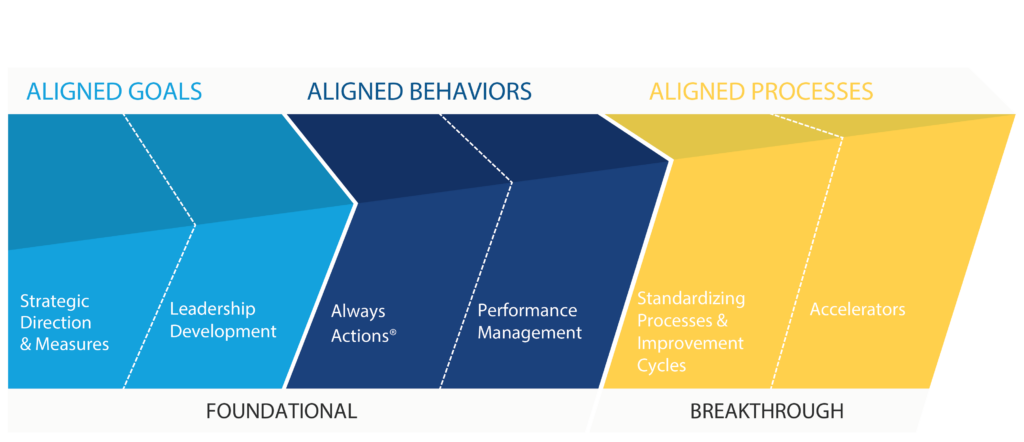
Action requires a clear roadmap. The plan outlines the tasks, deadlines, assigned responsibilities, and necessary resources and keeps leaders focused on and accountable for the most important work. This systematic approach breaks down the implementation of continuous improvement into manageable actions for leaders to follow.
School Leadership Strategies for Staying Focused Without Overwhelming Teams
Among the most impactful school leadership strategies is the deliberate choice to concentrate on one critical improvement area at a time. By concentrating on just one thing, organizations avoid overwhelming people.
Initiative fatigue is a crippling reality in modern education. A 2026 analysis on organizational performance by the Society for Industrial and Organizational Psychology (SIOP) highlights that doing more tasks, initiatives, or programs does not automatically equal greater impact. Instead, repeated organizational change, combined with heavy workloads and uncertainty, directly drives emotional exhaustion and systemic burnout.
Education leaders build lasting success by slowing down to speed up, mastering one foundational element first—whether that is the employee experience, family and student experience, or department support services. Author James Clear encourages leaders to focus on incremental progress, advocating efforts to improve by 1% daily. According to Clear, these tiny gains, when compounded over a year, lead to performance that is 37 times better. Breaking performance into small, daily improvements makes consistent effort feel less daunting and more achievable.
How Do Scorecard and Stoplight Reviews Help Leaders Model Accountability?
Scorecard and stoplight reviews help leaders model accountability by providing a clear, visual method for reviewing progress honestly and consistently. At the conclusion of the first three quarters, executives record progress for the quarterly measures on their scorecards. Then they code the results green (at or above goal), yellow (progress made but not at goal), or red (significantly below goal).
This transparent process frames accountability as a powerful tool for learning rather than a mechanism for blame. Transparent progress reviews show that executives hold themselves to the very same standard of ownership they demand from their staff. Sharing the organizational scorecard stoplight transparently builds trust with interested external audiences and promotes confidence within the community.
How Do Effective Leaders Learn From Results and Adjust Over Time?
Effective leaders learn from results and adjust over time by actively reflecting on empirical data, stakeholder feedback, and honest team conversations. Using structured after-action reviews, leaders rigorously assess their performance to identify successes and failures, ultimately driving performance improvement.
During these reflections, leaders ask critical questions:
- What did we expect?
- What actually happened?
- Where did we succeed, and why?
- Where was there a performance gap, and why?
These reflections empower leaders to pinpoint bright spots to replicate and gracefully pivot future actions. Conducting reviews quickly, while the information is fresh in people’s minds, ensures teams can use insights immediately to improve performance.
How Does the Organizational Excellence Flywheel Sustain Leadership Momentum?
The organizational excellence flywheel sustains leadership momentum by illustrating how creating inspiring workplaces naturally builds strength in people, which rapidly accelerates high-performing results. As individuals experience tangible progress, deep trust, and clear alignment, their daily efforts begin to compound dramatically.
This process causes the flywheel to spin faster, creating tight alignment and accountability among teams. Sitting at the flywheel’s center is purpose, worthwhile work, and making a difference. The spinning flywheel keeps educators’ passion burning brightly. Effective leaders keep this work moving by tirelessly building capacity and sustaining improvement over time.
How Studer Education Helps Districts Strengthen Effective School Leadership
Transforming a district’s trajectory is monumental work, and no executive team should have to navigate it in isolation. Sustaining excellence demands a relentless focus on core behaviors, strategic alignment, fierce accountability, and continuous improvement. Studer Education partners alongside districts to build the exact leadership practices necessary to unite culture, strategy, and measurable goals organically.
Explore the 9 Pillars of Leadership Excellence to see how these foundational principles systematically support district outcomes. Once districts establish the pillars, structured 90-day leadership engagement cycles empower districts to strengthen accountability, improve communication, and turn feedback into action through focused short-cycle reviews. To identify your most effective starting point, uncover your team’s greatest strengths by taking our Leadership Assessment.
Effective School Leadership FAQs
Effective leadership establishes the cultural and strategic tone for the entire district. It ensures that students, families, and employees consistently experience a supportive environment dedicated to continuous improvement and shared, measurable success.
The most effective strategies involve focusing on one specific improvement area at a time to prevent organizational burnout. They also include regular rounding, structured progress reviews, and actively recognizing organizational bright spots to scale operational success.
Strategic planning transforms overarching visions into clear, actionable, and measurable goals. It helps leaders align their daily behaviors and systemic processes to ensure every team member works efficiently toward the exact same destination.
Leaders sustain improvement by applying small, compounding daily habits and structured short-cycle reviews. Celebrating incremental progress keeps the organizational flywheel spinning rapidly and maintains remarkably high levels of team motivation and engagement.
Progress reviews visually track goals using a highly clear green, yellow, and red stoplight system. This radical transparency normalizes honest reflection, turning accountability into a deeply collaborative learning process rather than a punitive exercise.